

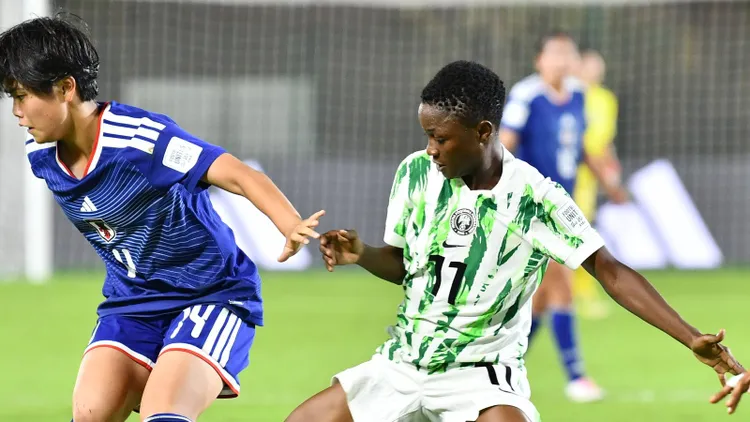
Nigeria's Flamingos did not just win the FIFA U-17 Women's World Cup in Rabat on 7 November: the 2-1 final win over Japan rewrote five records, and several of them reach well beyond youth football.
Awawu Bashiru opened the scoring in the 39th minute and Oluebube Umejiaku doubled the lead two minutes after the break. Fuki Ito pulled one back for Japan in the 80th minute, but the Flamingos held on at the Mohammed VI Football Complex.
Umejiaku collected the Golden Ball as the tournament's best player. These are the records the squad, captained by Chidera Harmony Chidi, now own.
1. Africa's first U-17 women's world champions
No African nation had won this trophy before, and none had even reached the final since 2008. Nigeria's run to the final was the country's first at this level, and they finished the job at the first attempt.
2. The first African women's world title at any level
Africa had never produced a women's world champion in a FIFA tournament, at senior or youth level. The Flamingos ended that wait and put this group in a bracket of its own among Nigerian women's teams.
3. Nigeria's first title in this competition
The women's U-17 trophy had always escaped Nigeria. Bashiru's goal, her latest after the brace that sent Nigeria past Brazil in the semi-final, and Umejiaku's strike settled that.
4. Only the second country to win both U-17 World Cups
Nigeria's men won the U-17 World Cup in 1985, 1993, 2007, 2013 and 2015. With this title, Nigeria join France, who won the men's tournament in 2001 and the women's in 2012, as the only countries to win both. That makes six U-17 world titles in all.
5. Champions after losing the opening game
No team had won the tournament after losing its first match. The Flamingos lost 2-1 to Poland in Group B, then won six in a row: Puerto Rico 2-0, two-time defending champions DPR Korea 3-1, Mexico 2-1, Venezuela 1-0, Brazil 3-1 and Japan 2-1.
Analysis: Why the Poland defeat was the making of this side
Losing the opener could have ended Nigeria's tournament inside a week. Instead, the response was six straight wins against some of the best youth programmes in the world, including the defending champions and Brazil.
That is the record that matters most for the future. Plenty of talented Nigerian youth sides have come home early; this group turned talent into a winning run under pressure, from a losing start.
The squad spent months preparing at the Remo Stars Stadium in Ikenne before leaving for Morocco, and groundsman Ebi Egbe, whose company built that pitch, told ThisDay the Rabat surfaces matched what the players had trained on. A long, settled camp on a good surface is something Nigerian teams do not always get, and the result is a case for giving the next group the same.
The next test is the step up. Several of these players should soon be pushing for places at under-20 level and, before long, with the Super Falcons, and the experience of winning a World Cup final could prove just as valuable as any of the five records.
For more on how the run unfolded, read our piece on Bashiru's brace against Brazil and the road to the final, and our quarter-final preview against Venezuela.